
For most of modern business history, growth has been associated with expansion. More customers required more employees, larger offices, additional departments, and increasingly complicated operations. Building a successful company often meant building an organization capable of managing all those responsibilities.
The internet began changing that relationship. Websites allowed small businesses to reach international markets, e-commerce eliminated the need for physical storefronts, and digital marketing gave independent entrepreneurs access to audiences that once required substantial advertising budgets.
Now, artificial intelligence is introducing another transformation, one that I believe could redefine what it means to operate a business.
We are entering the era of the one-person AI business.
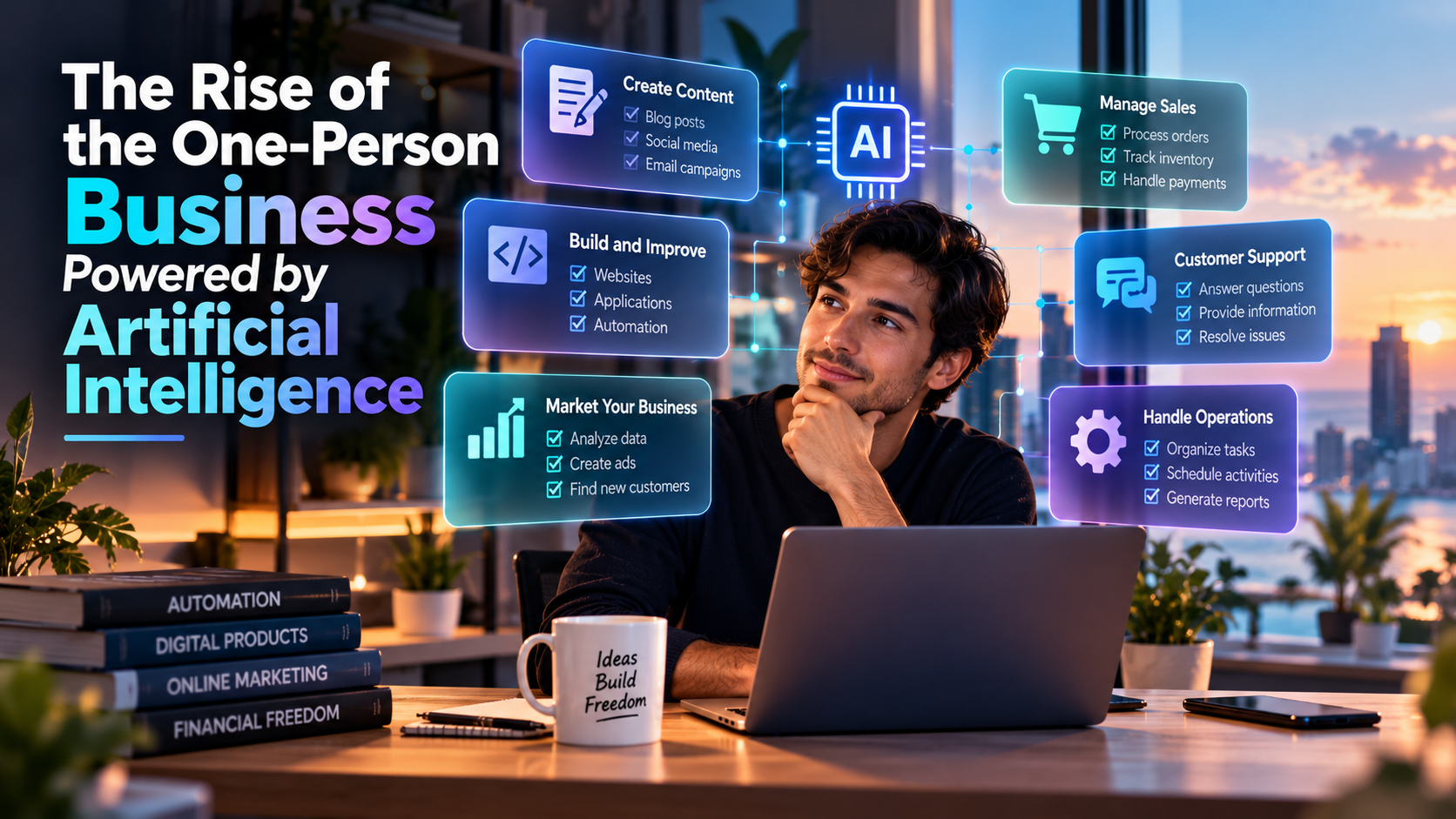
Imagine an entrepreneur who manages a website, develops products, creates marketing campaigns, communicates with customers, processes orders, and analyzes performance without maintaining a traditional team of employees. Until recently, that level of operational independence would have been extremely difficult, particularly as the business grew.
Today, AI-powered software and automation are making parts of that scenario increasingly practical.
This does not mean artificial intelligence can independently operate every aspect of a company or that employees are becoming unnecessary. Businesses still require judgment, accountability, customer relationships, and specialized expertise. However, the amount of work one person can accomplish with the right technology is changing significantly.
Having spent much of my professional life developing websites, building software, and working with digital marketing automation, I find this evolution particularly interesting. I have always been attracted to the idea of using technology to create businesses that can operate efficiently without requiring an unnecessarily complicated structure.
Artificial intelligence is bringing that possibility closer to reality.
How Artificial Intelligence Is Redefining Entrepreneurship
The idea of a one-person business is not new. Freelancers, consultants, independent developers, authors, and online entrepreneurs have operated successful businesses independently for decades.
What is changing is the range of activities that one individual can realistically manage.
In the past, an entrepreneur launching an online business might need assistance with website development, graphic design, content creation, customer support, accounting, and marketing. Even relatively simple projects could require several specialists or considerable personal time.
Today, artificial intelligence can assist with many of these responsibilities.
A business owner can use AI to research market opportunities, develop website content, analyze customer behavior, create advertising concepts, and organize operational information. Software development assistants can accelerate certain programming tasks, while automation platforms can connect applications and reduce repetitive administrative work.
Perhaps the most interesting development is the emergence of agentic AI, which introduces systems capable of planning and executing sequences of actions within defined permissions.
Traditional automation generally follows predetermined instructions. Agentic systems can sometimes interpret a broader objective, select appropriate tools, and adapt their actions based on the results.
Consider an online entrepreneur who receives inquiries from potential customers through several communication channels. Instead of manually organizing every message, a properly configured system might categorize inquiries, prepare responses, update customer records, and schedule follow-up activities.
More complex situations can still be directed to the business owner.
The objective is not necessarily to remove human participation. It is to reserve human attention for decisions that actually require it.
I see this distinction as one of the most important aspects of AI-driven entrepreneurship.
Technology should not simply help us work faster. It should help us spend less time on repetitive activities so we can concentrate on strategy, innovation, and building meaningful relationships with customers.
This is especially valuable for entrepreneurs who have limited financial resources but possess specialized knowledge.
A software developer can build and maintain a digital product with AI assistance. A marketing consultant can use automation to manage recurring reporting and campaign administration. An author can coordinate publishing, distribution, and promotional activities through connected digital systems.
These tools do not eliminate the need for expertise, but they can extend the capabilities of people who already understand their industries.
That creates opportunities for individuals who previously lacked the resources to compete with larger organizations.
Building a Business That Works Without a Traditional Team
One of the misconceptions surrounding AI entrepreneurship is that the technology itself creates the business.
It doesn’t.
Artificial intelligence can help execute tasks, but it cannot guarantee that customers want what you are selling. It cannot automatically create a sustainable business model, and it certainly cannot eliminate the financial realities of operating a company.
Before thinking about automation, an entrepreneur still needs to identify a problem worth solving.
This is something I have emphasized throughout my career in online business. Technology is valuable when it serves a clear purpose. A sophisticated website without customers is still an unsuccessful website, and an automated business without a viable product is simply an efficient way to accomplish very little.
The strongest opportunities for one-person AI businesses often begin with specialized knowledge.
Someone with experience in a particular industry may understand problems that general-purpose technology companies overlook. By combining that knowledge with AI tools, the entrepreneur can develop services or products tailored to a specific audience.
For example, a consultant specializing in local businesses might offer automated customer communication and appointment management. A developer could create a subscription-based software product for a particular professional industry. An educator might build digital courses supported by personalized learning tools.
These models have different requirements, but they share an important characteristic. The entrepreneur uses technology to deliver value without necessarily increasing operating expenses at the same rate as revenue.
Subscription-based digital products are particularly interesting because they can create recurring revenue. However, recurring revenue also creates recurring obligations. Customers expect reliability, technical support, continuous improvement, and responsible handling of their information.
A one-person business still needs to provide those things.
This is where thoughtful automation becomes important.
A well-designed system can help manage subscriptions, organize customer information, send appropriate notifications, and identify issues requiring attention. But it also needs safeguards, monitoring, and procedures for handling situations that automation cannot resolve.
The same principle applies to customer service.
An AI assistant may successfully answer common questions, but customers should have a reasonable way to reach a human when necessary. Automated responses should not pretend to know information they cannot verify, and sensitive decisions should receive appropriate oversight.
I believe entrepreneurs who understand these limitations will build stronger businesses than those who assume AI can operate indefinitely without supervision.
There is also a financial consideration that deserves attention.
Although AI tools can reduce certain expenses, they are not free. Software subscriptions, API usage, hosting, advertising, payment processing, security, and maintenance can accumulate quickly.
An entrepreneur using ten different automation services may discover that the monthly operating costs are considerably higher than expected.
The objective should be to create an efficient business, not simply an impressive collection of technology.
In my experience, simplicity is often an advantage. A small number of reliable systems that work together effectively can be more valuable than a complicated infrastructure requiring constant attention.
The real benefit of AI is not that it allows one person to imitate a large corporation.
It is that it can allow one person to accomplish meaningful work without needing to become one.
The Future of Independent Business and Digital Freedom
What excites me most about the rise of the one-person AI business is not the possibility of eliminating employees or replacing traditional organizations. It is the potential to give individuals greater control over how they earn a living.
For many people, entrepreneurship has always represented independence. The ability to choose what to build, whom to serve, where to work, and how to organize their time can be enormously appealing.
The internet made location-independent businesses possible. Artificial intelligence may make some of those businesses easier to operate.
An entrepreneur can manage customers in different countries, sell digital products internationally, and coordinate business activities through connected systems. Tasks that previously required constant manual attention can increasingly be supported by software.
But freedom and automation are not the same thing.
A poorly designed business can become just as demanding with AI as it was without it. If an entrepreneur spends every day correcting automated mistakes, monitoring unreliable systems, or responding to dissatisfied customers, the technology has not created freedom.
It has simply introduced a different form of work.
That is why I believe the future of independent entrepreneurship will depend on understanding both technology and business fundamentals.
Successful entrepreneurs will need to recognize which activities should be automated, which decisions require human judgment, and where personal relationships create the greatest value.
They will also need to take security, privacy, and regulatory obligations seriously. A small business does not become exempt from its responsibilities simply because artificial intelligence performs some of its operations.
Customer information still needs protection. Advertising claims must remain accurate. Financial records must be maintained. Applicable laws and contractual obligations still matter.
As AI systems become more capable, these responsibilities may become even more important.
There is another dimension to this transformation that I find especially meaningful.
For years, the conventional definition of business success has often involved building something increasingly large. More employees, more offices, more departments, and more operational complexity.
But perhaps technology is allowing us to reconsider that definition.
What if success means building a profitable business that supports the life you actually want to live?
What if an entrepreneur prefers a smaller operation that provides financial stability, flexibility, and time for personal interests rather than managing hundreds of employees?
There is nothing inherently wrong with building a large company. Some businesses genuinely require substantial teams, and human collaboration remains essential to many forms of innovation.
But size should not be the only measure of achievement.
I believe artificial intelligence is expanding the range of choices available to entrepreneurs.
Someone with valuable expertise, a clear business model, and the discipline to build reliable systems may be able to create a sustainable company with fewer resources than previous generations required.
That possibility deserves attention.
In my book Online Magic, I discuss the importance of understanding how websites, marketing, and digital tools work together to create opportunities online. The arrival of AI adds another dimension to that philosophy, but the underlying principle remains unchanged.
Technology creates possibilities. Knowledge and execution turn those possibilities into results.
The one-person AI business is not a guarantee of effortless income, and it should not be promoted as a shortcut to financial success. Entrepreneurship will continue requiring patience, experimentation, responsibility, and the willingness to solve difficult problems.
What artificial intelligence offers is leverage.
It allows individuals to extend their capabilities, reduce certain operational barriers, and explore business models that might previously have been beyond their reach.
As these technologies continue developing, I expect we will see more independent entrepreneurs building specialized software, digital services, educational products, and online businesses supported by increasingly intelligent systems.
Some will remain intentionally small. Others will eventually grow into larger organizations. Both approaches can be successful when they are built around real customer needs.
The most important change may be that entrepreneurs will have greater freedom to decide which path they want to follow.
For me, that is the real promise of the one-person AI business.
Not a future where machines do everything and people become irrelevant, but one where technology gives individuals more opportunities to create, compete, and build something meaningful on their own terms.
The internet gave us the ability to reach the world from a computer.
Artificial intelligence is beginning to expand what we can accomplish once we get there.