
There’s a mistake I see people make over and over again when they enter the AI space. They go after the obvious. They build another chatbot, another content tool, another automation app that looks just like everything else already out there. Then they wonder why it’s hard to stand out.
What I’ve learned over the years is simple. The real opportunity is never in the obvious. It’s always in the niches.
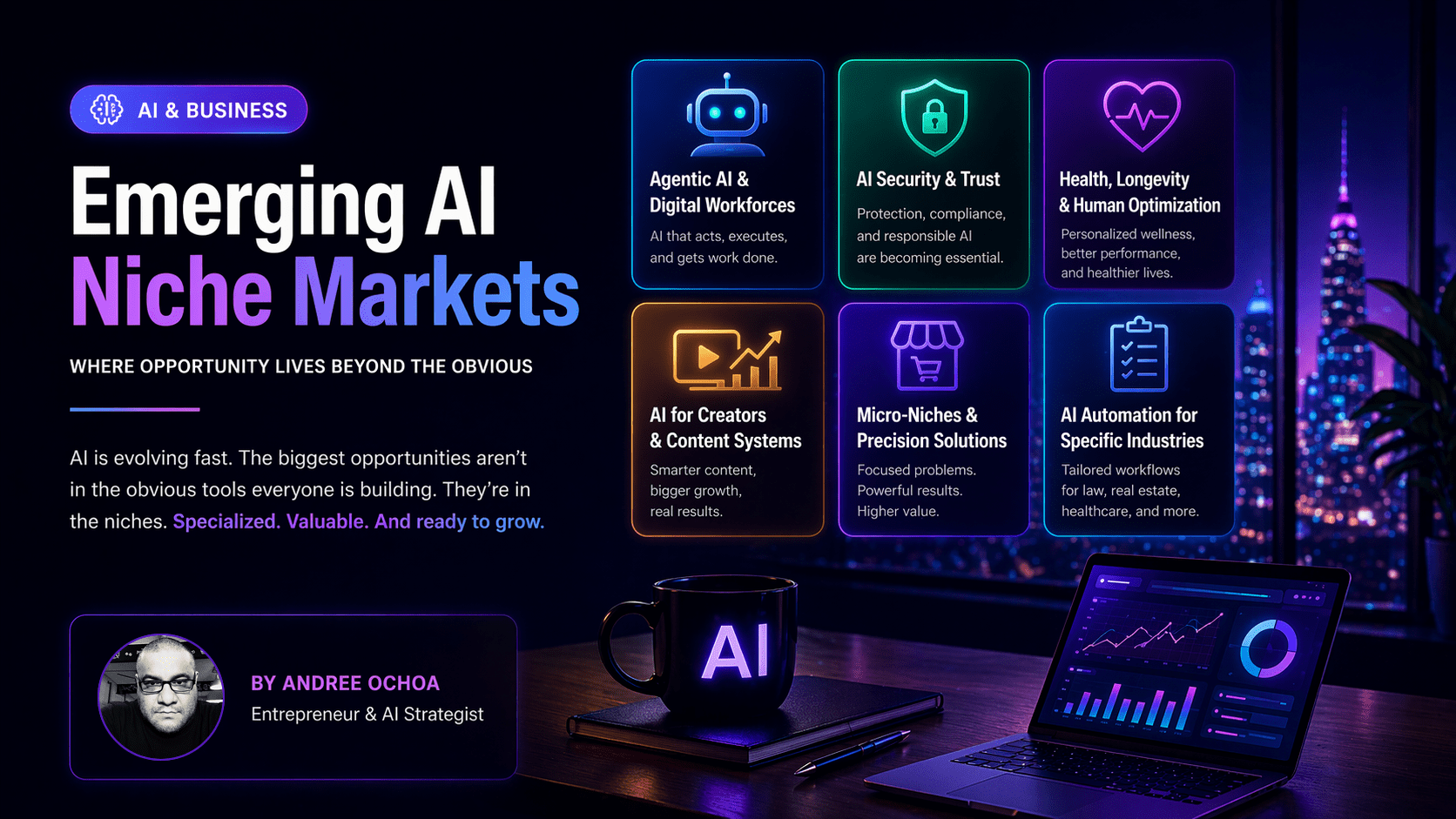
Emerging AI niche markets are where things get interesting. That’s where real problems exist, where demand is growing quietly, and where businesses are willing to pay because the solution actually matters. This is where AI stops being a trend and starts becoming a business.
Right now, we’re in a moment where these niches are forming faster than ever. If you know how to look, you can see them before they become crowded.
The move toward specialization
In the early days of AI, everything was broad. Tools were designed to do a little bit of everything. Write content, answer questions, generate ideas, automate simple tasks. That phase was necessary because it proved the technology worked.
But now, businesses want more than that. They want precision. They want AI that understands their industry, their workflow, and their customer.
A law firm does not want a generic AI assistant. They want one that understands legal language. A medical practice needs systems that respect compliance and patient data. A real estate company wants automation that fits their sales cycle.
This is where niche markets start to form.
The shift is subtle, but powerful. AI is no longer about doing everything. It’s about doing one thing extremely well. And when you solve one specific problem better than anyone else, you become valuable very quickly.
The rise of AI that actually works for you
One of the most exciting spaces I’m seeing right now is what I would call AI that works for you, not just with you.
We’re moving beyond tools that wait for instructions. AI is starting to act. It follows up with leads, schedules appointments, answers questions, organizes data, and completes tasks without constant supervision.
This is where things get real.
Businesses don’t just want AI that helps. They want AI that executes. Something that removes work from their plate, not something that adds another tool to manage.
And here’s where the opportunity is. Most companies don’t know how to implement this properly. They understand the idea, but not the execution.
That gap creates an entire niche market around integration, customization, and workflow design. The people who understand how to connect AI to real business processes are the ones who will dominate this space.
Trust is becoming a business
There’s another niche forming right now that most people are overlooking. And that’s trust.
As AI becomes more powerful, people are starting to ask questions. Can I trust this output. Where is my data going. Is this system secure. Is it compliant.
These are not small questions. They are business critical.
Companies are realizing that adopting AI is not just about efficiency. It’s about responsibility. One mistake, one data leak, one bad decision made by an automated system can damage a brand overnight.
So now, there is a growing demand for AI systems that are secure, transparent, and compliant.
This creates a niche that goes beyond technology. It’s about governance, safety, and accountability. Businesses want solutions that don’t just work, but that they can trust.
And trust, in this space, is something people will pay for.
The human side of AI niches
Not all AI niches are technical. Some of the most powerful ones are deeply human.
Take health, for example. AI is being used to analyze habits, optimize performance, and personalize wellness. People are using it to understand their sleep, their stress, their recovery, and their overall health.

This is not about technology. It’s about feeling better, living longer, and improving quality of life.
And when you tap into something that personal, demand becomes emotional. People don’t hesitate to invest in solutions that improve their well-being.
The same thing is happening in content creation. AI is helping people build brands, grow audiences, and monetize their knowledge. But again, the real opportunity is not in generic tools.
It’s in systems built for specific outcomes.
AI for YouTube creators.
AI for real estate agents.
AI for local businesses trying to generate leads.
The more specific the use case, the more valuable the solution becomes.
Small niches are the real gold
One of the biggest lessons I’ve learned is that smaller markets often outperform bigger ones.
It sounds counterintuitive, but it makes sense when you think about it. When you target everyone, your message becomes weak. When you target a specific group, everything becomes clearer.
AI makes this easier than ever.
You can build systems tailored to a very specific audience. You can automate processes that fit their exact needs. You can speak their language.
Instead of building for businesses, you build for dentists.
Instead of building for e-commerce, you build for Amazon sellers in a specific category.
Instead of building for marketing, you build for agencies that run Facebook ads.
This level of focus creates stronger results, better conversions, and higher perceived value.
And once you dominate a niche, expanding becomes much easier.
Why most people miss these opportunities
The reason most people miss emerging AI niche markets is because they follow noise instead of patterns.
They chase what is trending on social media. They copy what others are building. They focus on tools instead of problems.
But markets are built on problems.
If you want to find opportunity, you don’t look at what AI can do. You look at what people struggle with.
Where are businesses losing time.
Where are they losing money.
Where are they overwhelmed.
That’s where AI becomes valuable.
The technology itself is not the advantage anymore. Access is easy. Everyone has it.
The advantage is understanding how to apply it.
Where things are going
From everything I’m seeing, AI is heading in a very clear direction.
More specialization.
More automation.
More integration into daily workflows.
More focus on trust and compliance.
More personalization.
The companies that win will not be the ones building the most features. They will be the ones solving the most relevant problems.
And those problems are found in niches.
What excites me about emerging AI niche markets is not just the technology. It’s the opportunity to build something meaningful. To create systems that actually help businesses operate better, grow faster, and serve their customers more effectively.
This is not about chasing hype. It’s about positioning.
If you can identify where demand is growing and supply is still limited, you’re already ahead. If you can apply AI in a way that feels natural, useful, and reliable, you create value that lasts.
And in a world where everyone is trying to do everything, the people who choose to focus will always stand out.