

There was a time when artificial intelligence felt like a tool you had to constantly guide. You asked a question, it gave you an answer. You gave it a prompt, it produced an output. Everything depended on you pushing the buttons.
That is starting to change.
When people ask what is agentic AI, I tell them this is where AI begins to move from being reactive to becoming proactive. It is no longer just responding. It is acting. It is making decisions within a defined scope. It is executing tasks with a level of autonomy that starts to feel less like software and more like a digital assistant that actually gets things done.
And this shift is bigger than most people realize.
Understanding what is agentic AI
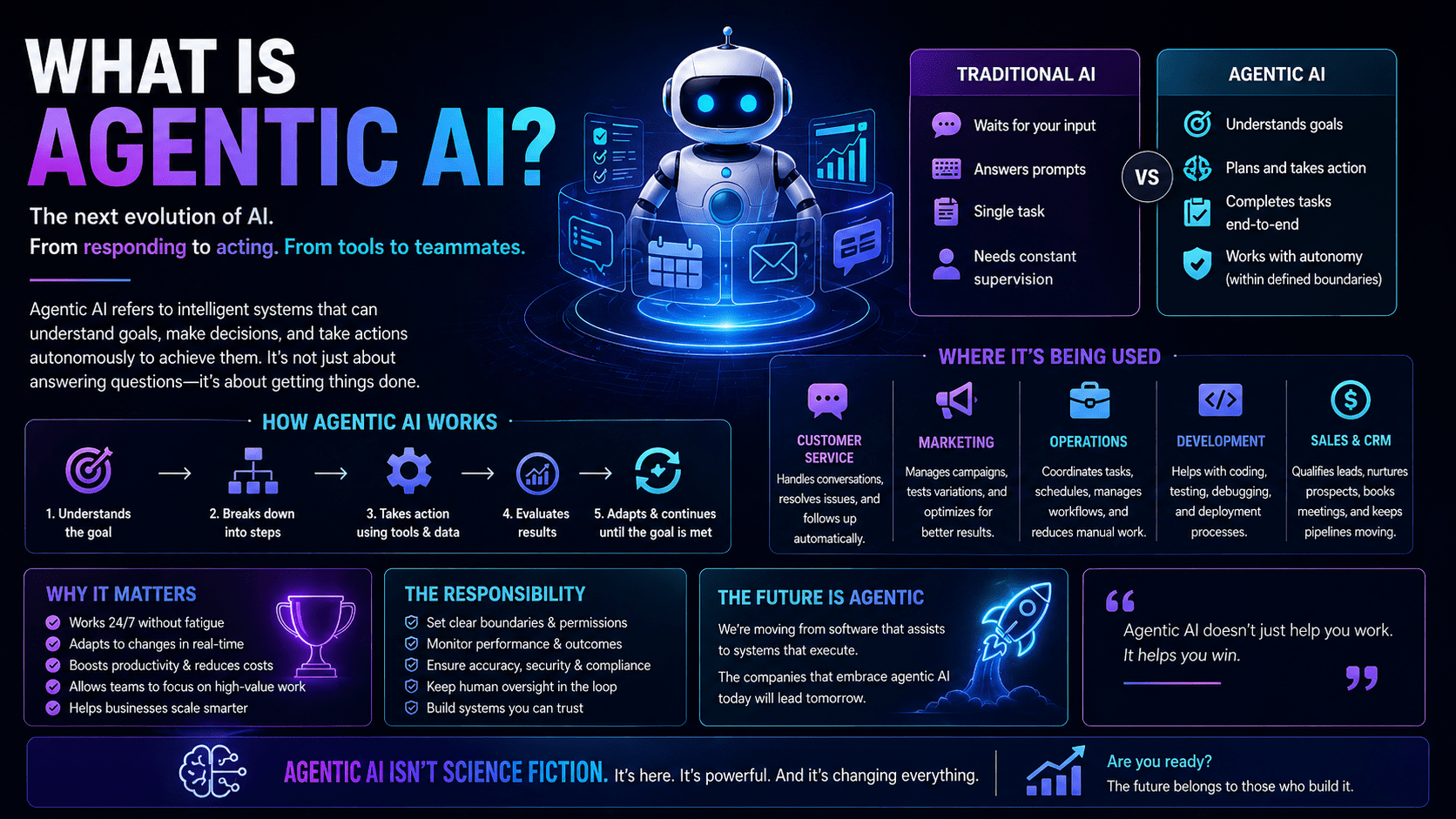
To really understand what is agentic AI, you have to look at the difference between traditional AI systems and agent-based systems.
Most AI tools today are still prompt-driven. They wait for input. They generate output. They stop. That interaction model is simple, but limited. It requires constant supervision.
Agentic AI works differently.
An agent is designed with goals, context, and the ability to take actions over time. Instead of answering a single question, it can break down a task into steps, execute those steps, evaluate the outcome, and continue working until the objective is complete.
Think about the difference.
A traditional AI might help you write an email. An agentic AI could identify a lead, draft the email, send it, follow up if there is no response, and update your CRM without you touching anything.
It is not just helping you think. It is helping you operate.
That is why agentic AI is being seen as the next evolution in artificial intelligence.
How agentic AI is changing the way businesses operate
From a business perspective, agentic AI is a shift in how work gets done.
For years, automation meant creating rules. If this happens, then do that. But real business environments are messy. Customers behave unpredictably. Data changes. Situations evolve.
Agentic AI introduces flexibility.
It can adapt based on context. It can prioritize tasks. It can make decisions within defined boundaries. It can coordinate actions across different systems.
This is where things get powerful.
Imagine a system that manages your entire customer journey. It captures leads, qualifies them, communicates across channels, schedules appointments, and keeps the pipeline moving. Not based on rigid rules, but based on intelligent decision making.
That is the direction we are heading.
And this is exactly where platforms like Merlin CRM begin to shine, because when you combine multi-channel communication with AI agents, you are no longer managing a business manually. You are orchestrating it.
The companies that understand this early will operate at a completely different level of efficiency.
The difference between automation and autonomy
One of the biggest misconceptions I see is people confusing automation with agentic AI.
Automation follows instructions. Agentic AI interprets objectives.
Automation is static. Agentic AI is adaptive.
Automation needs constant updates. Agentic AI can adjust based on feedback.
This difference is subtle, but it changes everything.
When you rely purely on automation, you spend time maintaining systems. When you introduce agentic AI, the system starts maintaining itself to a certain extent.
Of course, this does not mean full independence. There are still boundaries, safeguards, and oversight required. But within those boundaries, the system can operate with a level of autonomy that reduces manual effort significantly.
This is why I see agentic AI as less of a feature and more of a shift in architecture.
Where agentic AI is being used right now
If you look closely, is already being deployed across multiple industries.
Customer service is one of the most obvious areas. Instead of simple chatbots, companies are using AI agents that handle entire conversations, resolve issues, escalate when needed, and learn from interactions.
In marketing, agents are managing campaigns, testing variations, analyzing performance, and optimizing messaging without constant human intervention.
In operations, they are handling scheduling, logistics coordination, and internal workflows.
Even in software development, agent based systems are assisting with debugging, testing, and deployment processes.
The common pattern is this.
Anywhere there is a repetitive but variable process, agentic AI has an opportunity.
And those opportunities are everywhere.
The risks and responsibilities
With more autonomy comes more responsibility.
Agentic AI introduces new challenges that businesses cannot ignore.
When a system is making decisions and taking actions, you have to consider accuracy, accountability, and safety. What happens if it makes the wrong decision. What happens if it misinterprets context. What happens if it operates outside its intended scope.
This is why guardrails matter.
Clear boundaries. Defined permissions. Monitoring systems. Human oversight.
From my perspective, the companies that succeed with agentic AI will not be the ones that deploy it the fastest. They will be the ones that deploy it the smartest.
Trust becomes critical here.
If you cannot trust the system, you cannot scale it.
Why agentic AI matters for the future
When I step back and look at what is agentic AI in the bigger picture, I see a transition.
We are moving from software that assists to systems that execute.
We are moving from tools to digital operators.
We are moving from manual workflows to intelligent processes.
This is not just about saving time. It is about changing how businesses are structured.
Teams become leaner. Processes become faster. Decision making becomes more data driven.
And most importantly, the barrier to scaling drops significantly.
A small business equipped with agentic AI can operate with the efficiency of a much larger organization.
That changes competition.
That changes opportunity.
AI is still evolving, but the direction is clear. It represents a shift from interaction to execution. From assistance to action.
For those who understand it early, the advantage is not just technical. It is strategic.
Because once you stop thinking of AI as something you use, and start seeing it as something that works for you, everything about how you build and run a business begins to change.