
There was a time, not long ago, when every conversation about artificial intelligence revolved around one thing. Bigger. More powerful. More parameters. More data. Every headline celebrated the next massive model release as if size alone determined the future. It felt like we were watching a technological arms race where scale was the ultimate trophy.
But as we move deeper into 2026, I can feel the tone shifting. The excitement is still there, but it has matured. The question is no longer who built the largest model. The real question now is who knows how to use it properly.
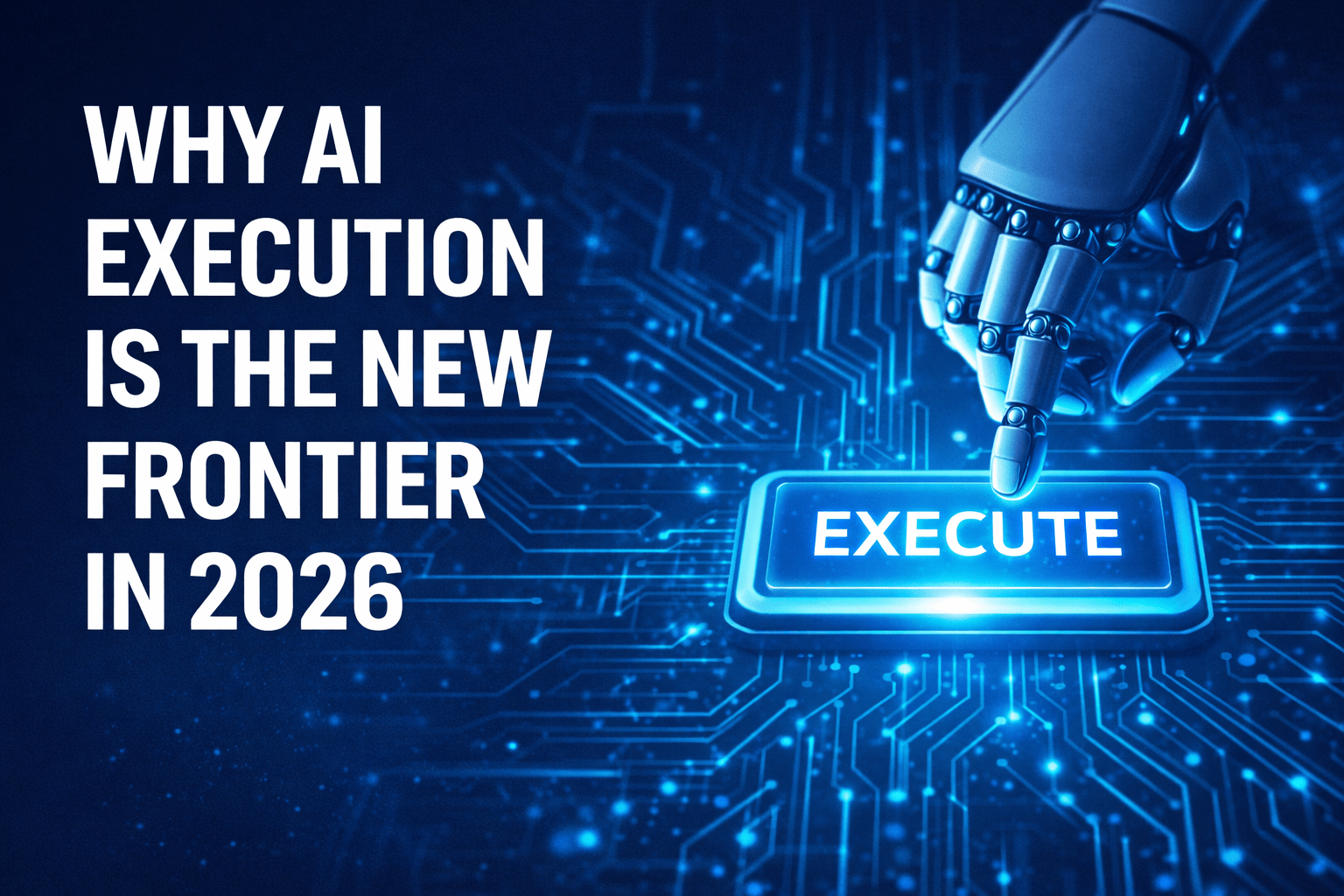
That is why I believe AI execution is the new frontier.
When I look at how businesses are interacting with artificial intelligence today, I see a pattern. The early adopters experimented. They integrated chatbots. They tested content generators. They automated small workflows. Some saw immediate gains. Others created chaos. What separated the winners from the frustrated was not access to better technology. It was execution.
Execution is the quiet discipline behind innovation. It is the difference between owning a Ferrari and knowing how to drive it at high speed without crashing.
In the early wave of generative AI, the spectacle dominated the narrative. We were mesmerized by machines writing essays, composing music, creating artwork, even coding entire applications. The demos were extraordinary. They felt like magic. And magic captures attention.
Businesses do not run on magic. They run on systems.
As I work with companies and entrepreneurs, I notice that the biggest breakthroughs are not coming from those who constantly chase the newest AI release. They are coming from those who integrate AI deeply into their workflows. They redesign processes around it. They train their teams. They measure performance. They refine continuously.
That is execution.
The reality is that we have reached a point where most advanced AI models are already incredibly capable. The marginal difference between one high end model and another often matters less than how it is implemented. If your data is disorganized, your team is untrained, and your workflows are chaotic, even the most powerful AI will underperform.
On the other hand, a well structured company with clear objectives can extract tremendous value from existing tools.
In 2026, I see a growing divide between organizations that treat AI as a feature and those that treat it as infrastructure.
The feature mindset is superficial. It says, let us add a chatbot to the website. Let us automate social media captions. Let us plug in an AI assistant and call it innovation. It looks impressive on the surface, but it rarely transforms operations.
The infrastructure mindset is different. It asks deeper questions. How can AI reduce friction across the entire customer journey. How can it optimize internal communication. How can it predict behavior. How can it improve decision making in real time. How can it support our team instead of replacing them.
When AI becomes infrastructure, it stops being a novelty and starts becoming a strategic asset.
One of the most interesting shifts I have observed is in enterprise environments. Large companies are no longer impressed by flashy AI demos. They want reliability. They want compliance. They want security. They want predictability.
Deploying AI inside a multinational corporation is not like launching a startup app. There are regulations. There are privacy laws. There are legacy systems. There are internal politics. There are cultural barriers.
Execution in this environment is complex. It requires patience and coordination. It requires leadership.

I have seen companies rush to deploy AI tools only to face resistance from employees who feel threatened or confused. I have seen teams overwhelmed by poorly integrated systems that create more work instead of reducing it. I have seen executives invest heavily in AI initiatives without a clear roadmap.
Execution is not glamorous. It involves documentation. It involves training sessions. It involves testing and iteration. It involves addressing edge cases and unexpected outcomes. It involves governance.
And governance is another reason why AI execution matters so much in 2026. As AI systems grow more autonomous, their impact grows more significant. If an AI makes a flawed recommendation in a casual chat, the consequences are minor. If it influences hiring decisions, financial approvals, or medical advice, the consequences are serious.
Responsible execution requires safeguards. It requires oversight. It requires transparency. Companies that ignore these elements may face legal and reputational risks that overshadow any productivity gains.
This is why the narrative around AI is evolving. We are no longer asking only what AI can do. We are asking how it should be used.
From my perspective as an entrepreneur, this is the moment where discipline becomes more valuable than excitement.
I see many founders chasing the next AI trend. They pivot their product every few months. They adopt every new model release without fully integrating the previous one. They confuse movement with progress.
The companies that will lead this decade are not those who move the fastest in random directions. They are those who move deliberately. They identify high impact areas. They integrate AI carefully. They monitor performance. They adapt intelligently.
There is also a deeper economic dimension to this shift. As AI tools become widely accessible, the competitive advantage no longer lies in access. It lies in mastery.
When everyone has access to powerful language models, the differentiator becomes who uses them better. When every marketing team can generate content instantly, the advantage goes to those who understand strategy, positioning, and audience psychology.
Execution amplifies human judgment. It does not replace it.
This is why I do not see AI as the end of human value. I see it as a catalyst for redefining it.
The professionals who thrive in this era will not be those who memorize technical specifications of models. They will be those who understand how to embed AI into workflows meaningfully. They will focus on orchestration rather than generation. They will combine critical thinking with machine speed.
In many ways, AI execution mirrors the early days of the internet. When websites first emerged, having one was impressive. Then it became standard. What mattered afterward was user experience, conversion optimization, and integration with business processes.
We are at that stage with AI now.
The novelty phase is fading. The integration phase has begun.
In 2026, I believe we will look back at this moment as the turning point where the conversation matured. Where we stopped obsessing over model size and started focusing on impact. Where we recognized that intelligence alone does not guarantee value. Application does.
AI execution is the new frontier because it determines whether artificial intelligence becomes a sustainable engine of growth or a chaotic experiment.
The frontier is no longer theoretical capability. It is operational excellence.
And those who understand this will not be distracted by the noise. They will build quietly. They will integrate deeply. They will execute relentlessly.
That is where the real transformation happens.