
Over the past year, a phrase has been circulating more frequently in conversations among AI researchers, CEOs, policymakers, and entrepreneurs. That phrase is AI tsunami warning. It sounds dramatic, almost apocalyptic. But behind the metaphor lies a serious concern. Artificial intelligence is advancing at a pace that many experts believe society is not fully prepared for.
When I first heard the term AI tsunami warning, I did not dismiss it as hype. I saw it as a signal. A signal that we are standing at the edge of something transformational. Not just incremental innovation. Not just another tech cycle. Something deeper. Something that will fundamentally reshape how we work, how we create value, and how we define professional identity.
In this article, I want to explore what the AI tsunami warning really means for the future of work. I want to unpack the fears, the opportunities, and the responsibilities that come with this moment. Most importantly, I want to discuss how individuals and businesses can position themselves intelligently instead of re-actively.
Understanding the Meaning Behind the AI Tsunami Warning
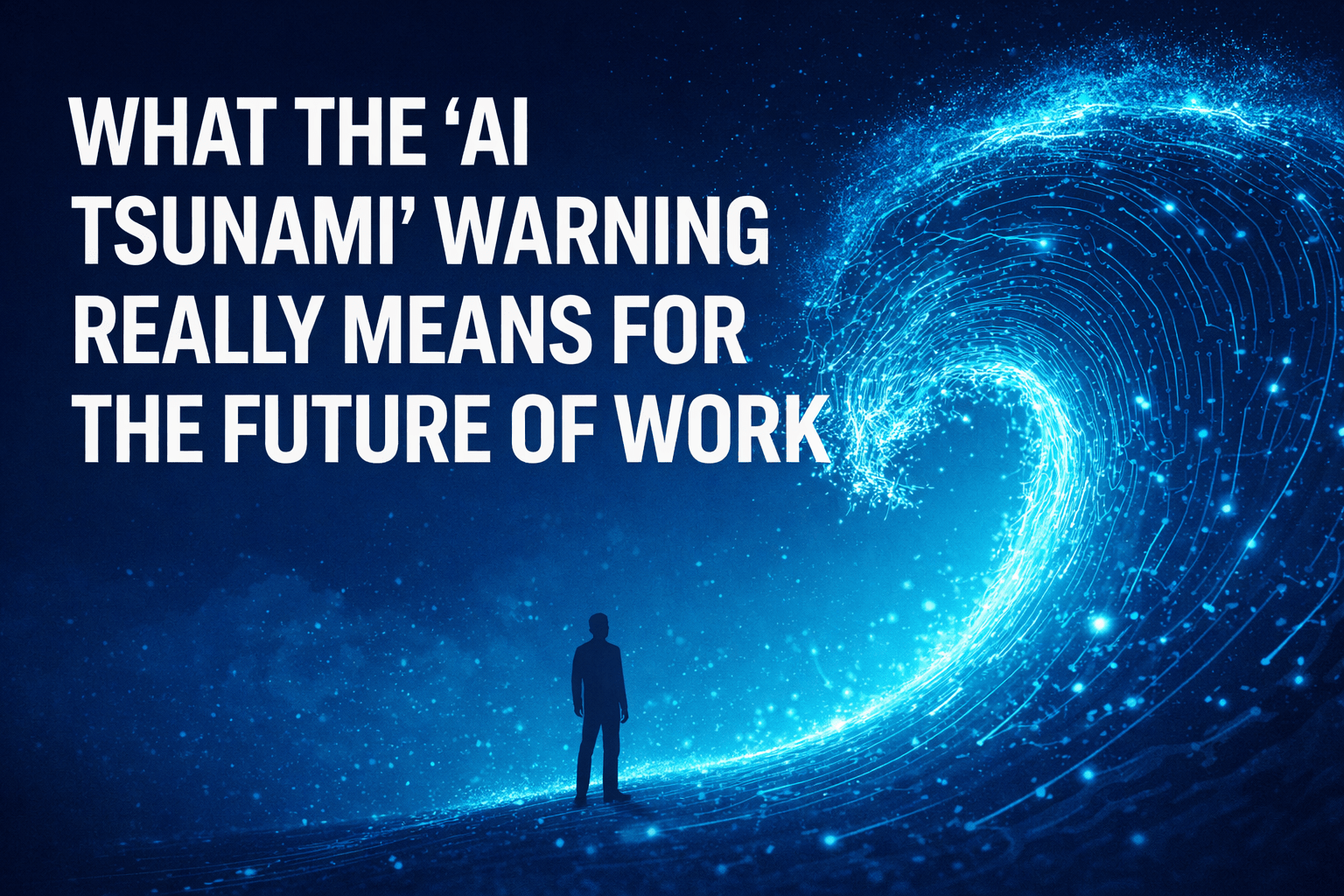
When experts talk about an AI tsunami warning, they are not predicting a single catastrophic event. They are describing a wave of accelerating capabilities that may overwhelm existing systems.
A tsunami is not just a large wave. It is a force created by deep structural shifts beneath the surface. That is exactly what is happening with artificial intelligence. Beneath the surface of everyday tools like chatbots and image generators, there is an explosion of computational power, data availability, algorithmic breakthroughs, and infrastructure investment.
Models are becoming more autonomous. They are not only generating text or images. They are reasoning, planning, coding, designing, analyzing, and even coordinating tasks across digital environments. Companies are integrating AI into core operations. Governments are scrambling to regulate what they barely understand.
The AI tsunami warning is about speed. It is about scale. It is about the realization that change is happening faster than most institutions can adapt.
Why the Future of Work Is at the Center of This Debate
Whenever technology evolves rapidly, work is the first domain to feel the pressure. We have seen this before during the Industrial Revolution and the rise of the internet. But artificial intelligence introduces a new dimension.
Previous technological revolutions automated physical labor or improved communication. AI automates cognition. It automates analysis, pattern recognition, decision support, and content creation. It does not just replace muscle. It enhances or replaces certain types of thinking.
This is why the AI tsunami warning feels different. It touches lawyers, accountants, designers, marketers, customer service agents, programmers, and even executives.
AI can now draft legal contracts. It can write marketing campaigns. It can debug software. It can generate financial reports. It can produce art. The barrier between human and machine creativity is no longer clear.
For some, this signals opportunity. For others, it signals threat.
Jobs at Risk and Jobs Being Reinvented
Let us address the difficult question directly. Are jobs going to disappear?
The honest answer is that some tasks will disappear. Repetitive cognitive tasks are especially vulnerable. Data entry, basic reporting, simple content drafting, routine customer responses, and certain coding tasks are already being automated.
However, history teaches us that technology does not simply destroy jobs. It reshapes them.
When spreadsheets were introduced, accountants were not eliminated. They evolved. When social media emerged, new careers were created that did not exist before. The same will happen with AI.
The AI tsunami warning is not about total job annihilation. It is about role transformation.
For example, a marketing professional who once spent hours writing basic email sequences may now focus on strategy, storytelling, and brand positioning while AI handles drafts and testing. A software engineer may rely on AI to generate boilerplate code and instead focus on architecture and problem solving.
The future of work will reward those who integrate AI into their workflows rather than compete against it.
The Acceleration Problem
One reason the AI tsunami warning is taken seriously is that the pace of development is unprecedented.
In previous technological waves, change occurred over decades. Industrial automation spread gradually. The internet took years to penetrate global markets.
AI adoption is happening in months.
A new model is released. Within weeks it is integrated into hundreds of tools. Businesses deploy it. Competitors respond. Productivity shifts.
This acceleration creates instability. Education systems cannot update curricula fast enough. Regulations lag behind innovation. Workers struggle to understand what skills will remain valuable.
The problem is not simply automation. The problem is unpredictability.
The Psychological Impact on Workers
Beyond economics, the AI tsunami warning carries psychological weight.
Many professionals are asking themselves difficult questions. Will my skills still matter in five years. Will AI outperform me. Should I pivot careers.
Uncertainty breeds anxiety. But it can also inspire reinvention.
The key is to separate fear from strategy. AI is not a conscious competitor plotting human replacement. It is a tool designed to optimize efficiency. The question is how humans position themselves alongside that tool.
Instead of asking whether AI will take your job, a better question is how AI can make you more valuable.
The Rise of AI Augmented Professionals
One of the most promising developments in this new era is the emergence of AI augmented professionals.
These are individuals who use AI as an amplifier. They combine human judgment, emotional intelligence, creativity, and ethical reasoning with machine speed and data processing power.
An AI augmented marketer can test campaigns in minutes instead of weeks. An AI augmented consultant can analyze large datasets instantly. An AI augmented entrepreneur can automate entire customer journeys while focusing on innovation.

This is not replacement. It is multiplication.
The AI tsunami warning becomes less frightening when viewed through this lens. The wave does not have to crush you. It can carry you forward if you learn to surf it.
The Responsibility of Businesses
The future of work is not solely the responsibility of individual workers. Businesses play a critical role in shaping how AI is deployed.
Companies must resist the temptation to treat AI as a pure cost cutting mechanism. If AI is used only to reduce headcount without investing in retraining and role evolution, the social consequences could be severe.
Forward thinking organizations are doing something different. They are retraining employees. They are redesigning roles. They are encouraging experimentation.
Instead of asking which employees to replace, they are asking how to upskill teams to work alongside AI.
This approach transforms the AI tsunami warning into an AI opportunity signal.
The Global Inequality Question
Another dimension of the AI tsunami warning involves inequality.
Countries and companies with access to advanced AI infrastructure may accelerate ahead of those without it. Workers who understand AI may command higher incomes. Those without digital literacy may struggle.
This creates a risk of widening economic gaps.
However, AI also has the potential to democratize opportunity. A small business owner in Colombia can now access advanced AI tools that once required massive corporate budgets. A freelancer in India can serve global clients using AI enhanced productivity.
The outcome depends on access, education, and intentional policy.
Education and Lifelong Learning
If there is one area where the AI tsunami warning demands immediate action, it is education.
Traditional education models were built for stability. Students learned skills that would remain relevant for decades. That model no longer works.
The future of work requires adaptability. It requires digital fluency. It requires understanding how AI systems operate, even at a basic level.
Lifelong learning is no longer optional. It is essential.
Professionals must continuously update their skills. Not necessarily to become AI engineers, but to understand how to leverage AI tools within their domain.
The workers who thrive in this new era will be those who treat learning as an ongoing process rather than a phase that ends with graduation.
Ethics and Governance
The AI tsunami warning also highlights ethical concerns.
As AI becomes more autonomous, questions about accountability, bias, misinformation, and decision making intensify. If AI systems influence hiring, lending, healthcare, or legal outcomes, who is responsible when errors occur.
The future of work is not just about productivity. It is about trust.
Businesses must implement transparent policies. Governments must create frameworks that encourage innovation without sacrificing safety. Workers must understand the ethical implications of the tools they use.
Without governance, the wave of AI could create unintended harm. With thoughtful governance, it can elevate society.
Why Panic Is the Wrong Response
Whenever a major technological shift occurs, panic is a common reaction. But panic rarely produces intelligent decisions.
The AI tsunami warning is not a signal to retreat. It is a signal to prepare.
The professionals who ignore AI risk irrelevance. The professionals who fear it excessively may paralyze themselves. The professionals who embrace it strategically will shape the future.
Change is uncomfortable, but stagnation is far more dangerous.
A Personal Perspective
From my perspective as an entrepreneur deeply involved in technology and digital systems, I see the AI tsunami warning as both a challenge and a privilege.
We are witnessing a moment that future generations will study in history books. The transformation of work, creativity, and communication through artificial intelligence will define this century.
I do not see this moment as the end of human value. I see it as the beginning of a new definition of it.
The value of humans will increasingly lie in vision, empathy, ethics, leadership, and imagination. Machines can generate outputs. Humans define meaning.
Preparing for the Future of Work
So what does preparation look like in practical terms.
It means learning how AI tools function within your industry. It means experimenting rather than resisting. It means focusing on uniquely human strengths.
It also means building adaptability into your mindset. The future of work will not be static. Roles will continue evolving. Tools will continue improving.
Those who cultivate resilience and curiosity will remain relevant.
The Opportunity Hidden Inside the Warning
The phrase AI tsunami warning sounds ominous. But warnings are not only about danger. They are about awareness.
Awareness creates change.
If society acknowledges the scale of change, it can act deliberately. Education systems can adapt. Businesses can retrain employees. Governments can design smart regulations. Individuals can pivot strategically.
The wave is coming. That much is clear. But whether it devastates or elevates depends on preparation and intention.
The future of work is not predetermined. It is being shaped right now by the decisions of entrepreneurs, engineers, policymakers, and workers. Artificial intelligence is accelerating faster than ever, but human adaptability has always been our greatest strength.
The AI tsunami warning should not freeze us in fear. It should awaken us to possibility. Those who understand the wave, respect its power, and learn how to navigate it will not be swept away. They will help define the next era of human productivity and creativity.